About 310 minutes
Was I right? — Inside the Classic
Science Fiction Utopias
71,256 recorded words. 13 minutes difference from this book's estimate.
View Gutenberg source #75393
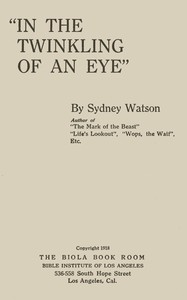
This digital edition of "In the twinkling of an eye" — Context and Discussion is described by source-level measurements including 68,114 words, 4 hr 57 min estimated reading time, and 34 detected text sections.
The text analysis averages about 18.2 words per sentence, while the detected sections provide another way to judge how the source is divided.
Project Gutenberg metadata also associates the work with “Christian fiction,” connecting these edition facts with the source record’s subject description.
Explore this collection
These alternatives are selected using recorded categories and estimated reading time.
About 310 minutes
Science Fiction Utopias
71,256 recorded words. 13 minutes difference from this book's estimate.
View Gutenberg source #75393About 276 minutes
Science Fiction Utopias
63,304 recorded words. 21 minutes difference from this book's estimate.
View Gutenberg source #70942About 254 minutes
Science Fiction Utopias
58,222 recorded words. 43 minutes difference from this book's estimate.
View Gutenberg source #75922Search stored excerpts and compare books → Choose by your preferences →
Choices use stored catalog measurements. Estimates vary with reading speed. A shared category is a catalog label, not a claim that two books have the same argument or literary quality.
Search reads excerpt text stored with this catalog and links to its associated Gutenberg record. The connection is stored in the site database; this tool does not recheck that every excerpt is word-for-word identical to that external record. Excerpt search does not cover every chapter and does not verify historical publication dates.
Catalog snapshot checked: 2026-09-25. Coverage: 95 public books, 95 available source excerpts.
Read the complete public-domain text at its original source.
Read on Project GutenbergSydney Watson's In the Twinkling of an Eye opens with an author's foreword that immediately establishes the book's defensive posture. Watson recounts a letter from a Temperance Committee objecting to a fictional character using brandy for first aid, using this to argue that narrow literalism misses life's complexities. This prefatory anecdote signals the novel's central tension: how to render sacred prophecy through fictional form without sacrificing doctrinal seriousness. The foreword acknowledges the influence of General Robertson's booklet Long Odds and confesses a five- or six-year struggle over the propriety of using fiction for eschatological teaching. Watson's voice here is earnest, slightly combative, and keenly aware of his audience's expectations.
The novel's protagonist, Tom Hammond, is an editor of The Courier, a daily paper. In the excerpt, he attends a Bible exposition where the speaker—a major—openly prays that the editor of The Courier might be 'captured for Christ.' Hammond's reaction is physical: he 'turned hot and cold' and hopes to leave unrecognized. Yet he is not offended, sensing that the major's 'soul rang true.' This moment crystallizes the book's narrative strategy: Hammond is a secular professional placed in religious settings, allowing Watson to dramatize the collision between journalistic objectivity and prophetic conviction. The reader observes Hammond's internal conflict through small bodily cues rather than lengthy introspection.
Watson embeds a lengthy extract from the Gentleman's Magazine of 1759, a letter signed 'M. Forster' that calculates the end of Turkish rule over Jerusalem by multiplying forty-two months by thirty days to yield 1,260 years. The major who reads this letter cautions against exact date-setting but defends 'approximate times.' This layered quotation—a fictional character reading an historical document—gives the novel a documentary texture. Watson does not simply assert prophecy; he presents it as a contested, scholarly tradition. The pacing slows during these passages, shifting from narrative action to exposition, which may challenge readers expecting a faster plot but rewards those interested in the period's theological debates.
The excerpts reveal a distinctive rhythm: scenes of personal drama (Hammond's discomfort, the foreword's anecdote) alternate with blocks of doctrinal lecture. The major's speech, for instance, moves from a plea for prayer to a historical citation to a direct appeal to the unconverted. Watson's sentences in these sections are longer, more periodic, and freighted with scriptural references. By contrast, the foreword's language is colloquial and anecdotal. This alternation creates a structural tension between storytelling and sermonizing. Readers should note how Watson manages transitions—often a character's question or a physical gesture (Hammond's blush) bridges the two modes. The novel's 68,000 words likely sustain this pattern of interruption and resumption.
Watson's novel is best approached as a hybrid: part theological tract, part conversion narrative, part period piece on early 20th-century eschatological fervor. The excerpts suggest that the book's interest lies less in plot mechanics than in the texture of its debates—the way prophecy is quoted, interpreted, and applied to contemporary events. Readers may find the pacing uneven, but the work rewards attention to its documentary layers and the quiet drama of a journalist's conscience.
I’ve often held In the Twinkling of an Eye and felt its patient waiting for a promised end, that hush before revelation. There’s a quiet kinship with Dr. Mabuse, master of mystery — Edition Insights, though one waits for light and the other for shadow. Both, I think, understand suspense—the long, breathless pause before the curtain lifts.
Create a short personal record of your experience with this book.