About 51 minutes
The trap — Edition Insights
Science Fiction Utopias
11,697 recorded words. 3 minutes difference from this book's estimate.
View Gutenberg source #73243
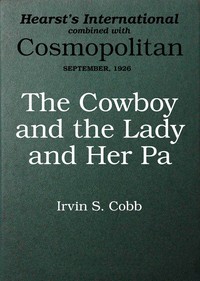
For The cowboy and the lady and her pa — A Closer Reading, the stored edition analysis reports 11,038 words, 48 min estimated reading time, and 3 detected text sections.
The text analysis averages about 18.6 words per sentence, while the detected sections provide another way to judge how the source is divided.
Project Gutenberg metadata also associates the work with “Short stories,” connecting these edition facts with the source record’s subject description.
Explore this collection
These alternatives are selected using recorded categories and estimated reading time.
About 51 minutes
Science Fiction Utopias
11,697 recorded words. 3 minutes difference from this book's estimate.
View Gutenberg source #73243About 40 minutes
Science Fiction Utopias
9,117 recorded words. 8 minutes difference from this book's estimate.
View Gutenberg source #71197About 61 minutes
Science Fiction Utopias
13,823 recorded words. 13 minutes difference from this book's estimate.
View Gutenberg source #73065Search stored excerpts and compare books → Choose by your preferences →
Choices use stored catalog measurements. Estimates vary with reading speed. A shared category is a catalog label, not a claim that two books have the same argument or literary quality.
Search reads excerpt text stored with this catalog and links to its associated Gutenberg record. The connection is stored in the site database; this tool does not recheck that every excerpt is word-for-word identical to that external record. Excerpt search does not cover every chapter and does not verify historical publication dates.
Catalog snapshot checked: 2026-09-25. Coverage: 95 public books, 95 available source excerpts.
Read the complete public-domain text at its original source.
Read on Project GutenbergThe story opens with the Gatling family—Mr. and Mrs. Hector Gatling and their daughter Shirley—on a wagon tour through Glacier National Park. While Mrs. Gatling rhapsodizes about the "prodigal" scenery and "picturesque types," Shirley's gaze is fixed elsewhere: on a cowboy. The narrator notes her "slim, trim figure in riding-boots and well-tailored breeches," a detail that signals her comfort with Western attire even as her parents remain tourists. The wagon boss, Dad Wheelis, addresses his mules with "affectionate violence," a phrase that captures the story's blend of rough humor and precise observation.
The catalog lists this as a "Western story" and a "short story," but the excerpts reveal a narrative more concerned with class and cultural collision than with cattle or gunfights. The Gatlings are "fish out of water," as the subtitle states, and the comedy arises from their attempts to interpret the West through Eastern sensibilities.
The excerpts showcase Cobb's use of dialogue to distinguish characters by region and class. Mrs. Gatling speaks in formal, appreciative phrases: "How prodigal nature is out in these Western wilds!" Shirley replies in the "argot of a newer and an irreverent generation," saying "Certainly does throw a wicked prod." Mr. Gatling, a businessman from Pittsburgh, adopts a pragmatic tone: "Not bad at all, so long as you don't have to hoof up any of 'em." The cowboy, when he appears, speaks with a directness that contrasts with the Gatlings' circumlocutions. Cobb does not overstate these differences; he lets the characters' word choices carry the weight. The dialogue also reveals the power dynamics within the family: Shirley's mother flinches at her slang, while Mr. Gatling negotiates with the cowboy in a scene that reads like a business deal.
A significant portion of the excerpt concerns Mr. Gatling's private interview with the young cowboy, Tripier. Mr. Gatling proposes a scheme: the cowboy will buy new clothes and accompany the family East, pretending to be a college man, all while keeping the arrangement secret from Shirley. The father's motivation is ambiguous: he says he must "find out—for her sake and ours—yes, and for his, too" whether the match is viable. The plan involves deception, and Mr. Gatling's conscience "smote him" briefly, but he proceeds. This plot device—a test disguised as a makeover—is a staple of romantic comedy, but Cobb grounds it in specific details: the cowboy has been "as far as Minot, North Dakota," and he will buy his suit from "Steinfelt and Immergluck" in Cree City. The father's insistence on "live colors" for the suit suggests a desire to remake the cowboy into an Eastern ideal.
Cobb devotes considerable attention to the physical environment, but the excerpts show that the setting serves primarily to highlight the characters' perceptions. The wagon train is described as "threading the trail like so many plodding ants," and the mules pause to contemplate the "abyss swimming in a green haze." These descriptions are filtered through the narrator's wry tone rather than through the characters' awe. Mrs. Gatling calls the park a "cathedral place," but the narrator undercuts her piety by noting that Shirley's eyes are elsewhere. The setting is not merely backdrop; it is a stage for the collision of Eastern and Western sensibilities. The cowboy is at home in this landscape, while the Gatlings are tourists who "saw enough landscapes to fill all the souvenir post-card racks of the world." Cobb uses the contrast between the Gatlings' appreciation of scenery and the cowboy's practical relationship with the land to underscore the cultural gap.
Readers should pay attention to the story's subtitle: "A Story of a Fish out of Water." The phrase applies not only to the cowboy in the East but also to the Gatlings in the West. Cobb's humor is gentle but pointed, and the excerpts suggest that the story's resolution may hinge on whether the characters can bridge their differences without losing their identities. The illustrations by James E. Allen, though not reproduced here, likely emphasize the visual contrasts between the characters' attire and the rugged landscape.
There’s a quiet kinship between Cobb’s Glacier Park tale, where a city girl’s polished manners meet a cowboy’s plain speech, and the cool, patient unraveling in The Benson murder case — Background and Themes. Both books trust that character shows itself in the smallest gestures—a lifted eyebrow, a pause before an answer—and I’ve always cherished that shared, unhurried attention.
Build a private reading journal entry for this title.