About 387 minutes
The Benson murder case — Background and Themes
Science Fiction Utopias
88,952 recorded words. 1 minutes difference from this book's estimate.
View Gutenberg source #70634
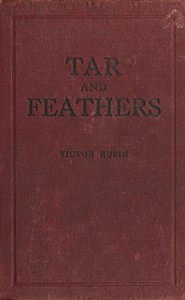
This digital edition of Tar and feathers — Background and Themes is described by source-level measurements including 89,171 words, 6 hr 28 min estimated reading time, and 41 detected text sections.
The text analysis averages about 13.3 words per sentence, while the detected sections provide another way to judge how the source is divided.
Project Gutenberg metadata also associates the work with “African Americans -- Fiction,” connecting these edition facts with the source record’s subject description.
Explore this collection
These alternatives are selected using recorded categories and estimated reading time.
About 387 minutes
Science Fiction Utopias
88,952 recorded words. 1 minutes difference from this book's estimate.
View Gutenberg source #70634About 372 minutes
Science Fiction Utopias
85,350 recorded words. 16 minutes difference from this book's estimate.
View Gutenberg source #75967About 412 minutes
Science Fiction Utopias
94,707 recorded words. 24 minutes difference from this book's estimate.
View Gutenberg source #75201Search stored excerpts and compare books → Choose by your preferences →
Choices use stored catalog measurements. Estimates vary with reading speed. A shared category is a catalog label, not a claim that two books have the same argument or literary quality.
Search reads excerpt text stored with this catalog and links to its associated Gutenberg record. The connection is stored in the site database; this tool does not recheck that every excerpt is word-for-word identical to that external record. Excerpt search does not cover every chapter and does not verify historical publication dates.
Catalog snapshot checked: 2026-09-25. Coverage: 95 public books, 95 available source excerpts.
Read the complete public-domain text at its original source.
Read on Project GutenbergThe novel opens not with a scene but with a foreword that frames the story as a reasoned argument against racial and religious antagonism, quoting Israel Zangwill. The first excerpt then drops readers into a post-war Southern town where Hamilton, a veteran, is being recruited into the Klan by Pinkney, a lumber company executive. The conversation is punctuated by physical details—a mauve rug, a glass-covered desk, a gold tooth—that ground the ideological pitch in material reality.
Rubin’s structure alternates between intimate interiors (offices, homes) and public spaces (streets, meeting halls), with movement often signaled by someone taking another’s arm or escorting them. This choreography of proximity and distance mirrors Hamilton’s internal conflict: he is literally guided toward Klan membership even as he recoils from the touch of the Black soldier who saved him.
Throughout the excerpts, hands and uniforms carry symbolic weight. Hamilton cannot bear to touch the colored hand of his savior, a visceral reaction that Rubin repeats to underscore prejudice as a physical aversion. Later, Pinkney takes Hamilton’s arm to escort him, a gesture of control disguised as camaraderie. The Klan’s regalia is never described directly in these passages, but the civilian uniforms of business—Pinkney’s office with its framed commission and diploma, Griffith’s checked suit and tan oxfords—suggest a parallel between civic respectability and Klan authority.
Rubin also uses the body as a site of memory: the phrase “over the top” grates on Hamilton because it cheapens his war experience. This sensitivity to language and physical sensation creates a texture of discomfort that runs beneath the polite conversations.
The novel’s structure relies on sharp transitions between settings. The excerpts jump from a foreword to a Klan recruitment meeting, with the war itself only present as memory. Hamilton’s movement through Corinth—from Pinkney’s office to the street, pausing to exchange words with acquaintances—is tracked with care, each step drawing him deeper into the organization. The concilium (a Klan council) is mentioned but not yet shown, creating anticipation.
Rubin uses these transitions to contrast the open camaraderie of the battlefield with the closed, conspiratorial spaces of the Klan. The office, with its soft rug and framed mementos, feels both luxurious and suffocating. The reader, like Hamilton, is led from one room to another, never quite sure what will be revealed behind the next door.
Rubin’s dialogue is layered with persuasive techniques. Pinkney speaks in flattery and euphemism, calling Griffith “the brains of the Tribe” and describing publicity as “the most potent weapon.” Griffith’s colloquialisms (“That’s just some o’ his bull”) contrast with Pinkney’s formal tone, showing two registers of Klan appeal. Hamilton’s responses are minimal—he nods, mumbles, makes small talk—revealing his passivity and discomfort.
The foreword’s rational, almost academic tone sets up a tension with the novel’s dramatic scenes. Rubin seems to be arguing against prejudice even as he depicts its mechanics. The excerpts do not resolve this tension, leaving the reader to watch Hamilton’s gradual entanglement.
Corinth is presented as a typical Southern town, but its geography is mapped through Klan activity. Pinkney’s office overlooks the main thoroughfare, placing the Klan at the center of civic life. The lumber company suggests an economy built on natural resources, while the framed American flag and commission tie the Klan to patriotism. Rubin does not describe the town’s layout broadly; instead, he focuses on specific interiors—offices, streets, meeting halls—that function as stages for recruitment.
The war is geographically distant (Flanders Fields), but its effects are felt in Corinth through Hamilton’s memories and the Klan’s appropriation of wartime language (“over the top,” “drives”). This layering of spaces—battlefield, town, office—creates a claustrophobic sense of inescapable influence.
Readers should attend to how Rubin uses physical objects—a gold tooth, a mauve rug, a framed poem—to signal status and ideology. The novel’s movement between public and private spaces mirrors Hamilton’s internal struggle, while the recurring motif of hands (to touch or refuse) offers a key to its emotional logic. The excerpts suggest a work more interested in process than outcome, documenting how prejudice is normalized through everyday interactions.
That gray afternoon, I kept returning to Rubin’s image of Hamilton’s hands—empty, then gloved in white. The rain softened everything outside, and the book’s tension loosened into something quieter, almost wistful, about people reaching across divides only to pull back. That mood carried me to When East met West — Themes and Context, where the same ache felt reframed, less theatrical, more like a lingering sigh between two old friends.
Save your reaction, strongest insight, and memorable passage.