About 417 minutes
The Black Abbot — Story, Setting & Ideas
Science Fiction Utopias
95,875 recorded words. 171 minutes difference from this book's estimate.
View Gutenberg source #75643
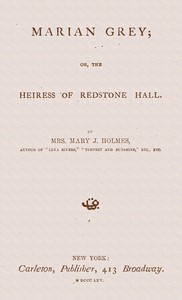
Marian Grey — Context and Discussion can be approached with a clearer sense of reading commitment from its source measurements: 135,075 words, 9 hr 48 min estimated reading time, and 33 detected text sections.
The text analysis averages about 23.8 words per sentence, while the detected sections provide another way to judge how the source is divided.
Project Gutenberg metadata also associates the work with “New York (N.Y.) -- Fiction,” connecting these edition facts with the source record’s subject description.
Explore this collection
These alternatives are selected using recorded categories and estimated reading time.
About 417 minutes
Science Fiction Utopias
95,875 recorded words. 171 minutes difference from this book's estimate.
View Gutenberg source #75643About 412 minutes
Science Fiction Utopias
94,707 recorded words. 176 minutes difference from this book's estimate.
View Gutenberg source #75201About 388 minutes
Science Fiction Utopias
89,171 recorded words. 200 minutes difference from this book's estimate.
View Gutenberg source #73731Search stored excerpts and compare books → Choose by your preferences →
Choices use stored catalog measurements. Estimates vary with reading speed. A shared category is a catalog label, not a claim that two books have the same argument or literary quality.
Search reads excerpt text stored with this catalog and links to its associated Gutenberg record. The connection is stored in the site database; this tool does not recheck that every excerpt is word-for-word identical to that external record. Excerpt search does not cover every chapter and does not verify historical publication dates.
Catalog snapshot checked: 2026-09-25. Coverage: 95 public books, 95 available source excerpts.
Read the complete public-domain text at its original source.
Read on Project GutenbergThe novel opens with a Gothic tableau: a dark night, black clouds, and Redstone Hall looming like a sentinel. The description of the swollen river rushing to meet its twin at 'The Forks of the Elkhorn' grounds the setting in Kentucky geography while the old man's haunted whisper—'Have you come again, Ralph Lindsey, to tell me of my sin?'—introduces a secret guilt. Holmes's diction here is deliberately atmospheric, using personification and sensory detail to create unease. The dialogue between guardian and ward is terse, with Marian's repeated 'Nothing' and her shuddering at the mention of the dead returning. This opening establishes a pattern: Holmes often uses setting to mirror psychological states, and her characters speak in ways that reveal more than they intend.
Holmes's prose in the first chapter leans heavily on Gothic conventions. The 'huge sentinel' of the hall, the 'sighing' wind, and the 'roar' of the river are not mere backdrop—they externalize the old man's guilt. The clock striking twelve, the 'shadowy corner,' and the question about the dead returning from the sea are stock Gothic elements, but Holmes grounds them in a specific Kentucky locale. The phrase 'The Forks of the Elkhorn' is a real place, lending authenticity. This blend of the familiar and the eerie recurs: the supernatural is hinted but never confirmed, as Marian 'conquering her weakness' dismisses the vision. Holmes's authorial choice is to keep the reader uncertain whether the haunting is real or psychological.
Ben, the Yankee peddler, speaks in a thick dialect that contrasts sharply with the novel's Gothic opening. His speech is full of malapropisms and colloquialisms: 'Bizness afore pleasure,' 'pretty slick,' 'through the mill.' He describes a horse's death with absurd detail—'safely landed on t'other side of Jordan where there wan't no omnibus drivers.' This comic voice serves multiple functions: it lightens the tone, provides information (he reveals Marian's name), and creates dramatic irony. Frederic fails to grasp Ben's hints about Marian Grey, while the reader may suspect more. Holmes uses Ben's loquacity to advance the plot without direct exposition, a technique that rewards attentive reading.
Holmes embeds meaning in names. The title character, Marian Grey, shares her surname with the mother of Frederic's first wife—a fact Ben mentions but Frederic misses. The name 'Marian' itself is repeated with emphasis: Ben says it is 'not a common name' and asks if Frederic has 'ever heard it afore.' The old man's guilt is tied to 'Ralph Lindsey,' a name that appears only in the opening. These nominal clues create a web of connections that the excerpts only partially reveal. Holmes's choice to withhold full explanation forces the reader to piece together relationships, a strategy that sustains mystery across the novel's length.
Holmes's dialogue often carries subtext. In the opening, the old man's question about the dead returning is met with Marian's 'No, the dead cannot come back,' but her shudder suggests doubt. Later, Ben's banter with Frederic is layered: his questions about marriage and his sister's name are probing, while Frederic's 'winced' reaction shows discomfort. The line 'I certainly have no such intentions' is undercut by Ben's skepticism. Holmes uses dialogue to reveal character—Ben's shrewdness, Frederic's evasion—and to plant information that may be misinterpreted. The reader must attend to what is left unsaid as much as what is spoken.
Readers of Marian Grey should attend to how Holmes balances Gothic atmosphere with domestic realism, and how she uses dialect and dialogue to convey character and plot. The excerpts suggest a novel that rewards patience: clues are dropped early but pay off later. Pay particular attention to Ben's seemingly random remarks and the recurrence of names—Holmes is a deliberate architect of suspense, and her authorial choices in diction and conversation are the keys to the story's design.
This note about Marian Grey and her shadowed halls reminded me of sitting on my grandmother's porch, hearing her speak of the old house where she grew up—how the stairwell creaked even when empty. That same quiet unease hummed through The trap — Edition Insights, where every name felt like a door left slightly ajar. I closed both books feeling I'd witnessed something, not just read it.
A brief reflection can help important ideas stay with you longer.