About 218 minutes
Esther — Inside the Classic
Adventure Picaresque Fiction
49,993 recorded words. 53 minutes difference from this book's estimate.
View Gutenberg source #74746
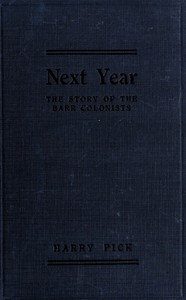
The catalog record for Next year — Context and Discussion provides practical reading context through 62,182 words, 4 hr 31 min estimated reading time, and 6 detected text sections.
The text analysis averages about 16.4 words per sentence, while the detected sections provide another way to judge how the source is divided.
Project Gutenberg metadata also associates the work with “Canada -- Emigration and immigration -- Fiction,” connecting these edition facts with the source record’s subject description.
Explore this collection
These alternatives are selected using recorded categories and estimated reading time.
About 218 minutes
Adventure Picaresque Fiction
49,993 recorded words. 53 minutes difference from this book's estimate.
View Gutenberg source #74746About 329 minutes
Adventure Picaresque Fiction
75,530 recorded words. 58 minutes difference from this book's estimate.
View Gutenberg source #69880About 207 minutes
Adventure Picaresque Fiction
47,498 recorded words. 64 minutes difference from this book's estimate.
View Gutenberg source #74912Search stored excerpts and compare books → Choose by your preferences →
Choices use stored catalog measurements. Estimates vary with reading speed. A shared category is a catalog label, not a claim that two books have the same argument or literary quality.
Search reads excerpt text stored with this catalog and links to its associated Gutenberg record. The connection is stored in the site database; this tool does not recheck that every excerpt is word-for-word identical to that external record. Excerpt search does not cover every chapter and does not verify historical publication dates.
Catalog snapshot checked: 2026-09-25. Coverage: 95 public books, 95 available source excerpts.
Read the complete public-domain text at its original source.
Read on Project GutenbergHarry Pick's Next Year opens with a sardonic author's note that immediately establishes its tone: the S.S. Lake Manitoba carried two thousand colonists in conditions far exceeding its Board of Trade rating, with single men packed three hundred to a cabin. The book styles itself a "semi-historical account" of the Barr Colonists, led by an "unscrupulous Church of England parson." Pick, himself a Barr Colonist, writes from experience, and the excerpts reveal a narrator who balances documentary impulse with a wry, sometimes mocking eye. The dialogue, thick with dialect and deadpan humor, drives much of the action, as when lost hunters Sam and Bert trade barbs about their predicament. The prose is lean, favoring concrete detail over sentiment, and the structure—chapter titles like "A Fight—Choosing land at Sea"—suggests a episodic, picaresque approach to the colonization story.
Pick renders the speech of his working-class colonists in heavy dialect, a choice that both authenticates their voices and creates comic friction. Sam, a Cockney character, says "abaht" for "about," "lawst" for "lost," and "blarsted" for "blasted." Bert, by contrast, uses more standard English, reflecting his "superior education." This linguistic divide becomes a source of humor and tension: when Sam fires off cartridges as a distress signal, he calls it "wot them blokes in books calls a distress single," and Bert dryly corrects him. The dialogue does not merely decorate; it reveals character and class dynamics. Sam's practical fatalism—"We've bin lawst ever since we left Liverpool"—undercuts Bert's anxious planning. Pick lets the men speak at length, their exchanges carrying the narrative forward without authorial intrusion. The effect is a kind of dramatic irony: the reader sees the absurdity of their situation more clearly than they do.
The prairie in Next Year is not a romantic wilderness but a disorienting maze. When Sam and Bert realize they are lost, the description emphasizes blockage: "The view horizontally was blocked by thickets of small brush." Openings lead only to "pretty little glades" that all look alike. Pick uses the landscape to generate both comedy and menace. The hunters' attempt to navigate by shooting at a tree or splitting up is patently foolish, yet the environment offers no clear cues. A horseman eventually finds them, his approach muffled by the terrain—a reminder that rescue is arbitrary. The setting is never merely backdrop; it actively shapes the plot. The chapter titles—"A May Snow-storm," "Prairie Fires," "Black Desolation"—promise a series of natural trials. Pick's colonists are not mastering the land; they are stumbling through it, and the prose keeps the reader grounded in their limited perspective.
Pick's narrator maintains a cool, ironic distance from the colonists' enthusiasm. The subtitle calls the Barr Colonists "far-famed" and their leader "unscrupulous," and the author's note mocks the ship's overcrowding. This skepticism extends to the characters' own self-regard. When Sam imagines shooting the Reverend Doctor Robbings, Bert "grins" at the thought—a moment of dark humor that the narrator reports without comment. The irony is structural: the colonists believe they are on a grand imperial adventure, but Pick repeatedly shows them as lost, petty, and ill-prepared. The title Next Year itself suggests perpetual deferral. The narrator does not need to editorialize; the gap between the colonists' rhetoric and their reality is made plain through juxtaposition. This technique gives the book a critical edge, distinguishing it from straightforward pioneer celebration.
The table of contents reads like a series of set pieces: "A Fight—Choosing land at Sea," "Saskatoon—Acquiring Transport," "An Early Morning Shoot." Each chapter focuses on a discrete incident or location, suggesting a picaresque structure where the protagonist (or collective) moves from one misadventure to the next. The excerpts bear this out: the lost-hunters episode is self-contained, with a beginning (they get lost), middle (they argue), and end (a horseman appears). Pick does not build toward a single climax but accumulates scenes. This episodic quality mirrors the colonists' own fragmented experience—a journey of disjointed challenges rather than a linear progress. The author's note, dated 1928, frames the book as a retrospective, twenty-five years after the events, which may explain the nostalgic yet ironic tone. Readers should expect a series of vignettes rather than a tightly plotted novel.
Next Year rewards attention to its language and structure. Pick's use of dialect, ironic narration, and episodic form creates a portrait of colonization that is both specific and skeptical. The book does not glorify the frontier; it shows people making do, getting lost, and cracking jokes. Readers interested in historical fiction that prioritizes voice over plot will find much to admire. Approach it as a collection of sharp, often funny scenes rather than a sweeping epic.
I've often thought the Barr colonists and the wanderers in The valley of Arcana — Themes and Context share a quiet kinship—both lost not in miles, but in the stories they carried. Harry Pick's emigrants stumble across prairie grass, while the other book's pilgrims drift through shadowed valleys. Each finds that home was never a place, merely a habit of hoping.
Your answers remain private and are stored only in this browser.