About 199 minutes
The haunted island — Background and Themes
Adventure Picaresque Fiction
45,558 recorded words. 31 minutes difference from this book's estimate.
View Gutenberg source #73917
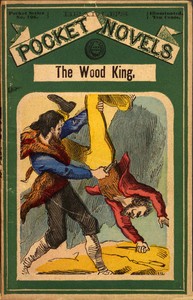
Before opening The Wood King; or, Daniel Boone's last trail — Key Ideas to Explore, the edition data offers a quick orientation: 38,427 words, 2 hr 48 min estimated reading time, and 4 detected text sections.
The text analysis averages about 15.6 words per sentence, while the detected sections provide another way to judge how the source is divided.
Project Gutenberg metadata also associates the work with “Adventure stories,” connecting these edition facts with the source record’s subject description.
Explore this collection
These alternatives are selected using recorded categories and estimated reading time.
About 199 minutes
Adventure Picaresque Fiction
45,558 recorded words. 31 minutes difference from this book's estimate.
View Gutenberg source #73917About 135 minutes
Adventure Picaresque Fiction
30,918 recorded words. 33 minutes difference from this book's estimate.
View Gutenberg source #68931About 205 minutes
Adventure Picaresque Fiction
47,001 recorded words. 37 minutes difference from this book's estimate.
View Gutenberg source #68936Search stored excerpts and compare books → Choose by your preferences →
Choices use stored catalog measurements. Estimates vary with reading speed. A shared category is a catalog label, not a claim that two books have the same argument or literary quality.
Search reads excerpt text stored with this catalog and links to its associated Gutenberg record. The connection is stored in the site database; this tool does not recheck that every excerpt is word-for-word identical to that external record. Excerpt search does not cover every chapter and does not verify historical publication dates.
Catalog snapshot checked: 2026-09-25. Coverage: 95 public books, 95 available source excerpts.
Read the complete public-domain text at its original source.
Read on Project GutenbergThe novel opens with a distinctive sound: two rifle shots followed by the yelping cries of Indians in pursuit. A hunter crossing the Osage river—revealed to be an old white man with bronzed skin and snowy locks—recognizes the danger and retreats to cover. The description of his appearance, with jean trousers rolled above knees showing white skin, establishes a contrast between his weathered exterior and his underlying age. This opening scene immediately places the reader in a familiar dime-novel setting: a lone frontiersman, alert to the sounds of the forest, interpreting the meaning of distant gunfire and war cries.
The excerpts repeatedly emphasize Boone's physical condition despite his age. When he presses through the forest with Abel Dare, the narrative notes "something of the fire of his younger days gleamed in his blue eyes and brought a flush to his bronzed cheek." His movements are described as quick and supple, his step light yet firm. The text does not dwell on his legendary past but instead shows him in action: running, listening, calculating distances. When he reaches the gorge, he severs a grape-vine with a knife, runs back a few paces, and swings across the ravine—a practical skill that the novel treats as a natural extension of his woodcraft. The author, Jos. E. Badger, avoids making Boone a superhuman figure; instead, the excerpts present a man whose experience compensates for any loss of youthful speed.
A separate plot thread follows the Kickapoo outcast Lightfoot, who is captured by Osages and condemned to death by fire. The description of his torture is graphic: smoke curling up a hollow shell, flames eating into rotten wood, leaves shriveling, his hair beginning to shrivel and his flesh to crack. Lightfoot responds with defiance, echoing the yells of his captors. This scene, drawn from the middle of the novel, contrasts with Boone's more strategic escape. The narrative shifts between the two characters, suggesting a structure that interweaves their fates. The excerpts do not reveal Lightfoot's ultimate fate, but the intensity of the description indicates that his suffering is a central set piece.
Boone's escape across the ravine is the most detailed action sequence in the excerpts. The text builds tension by noting that Boone initially errs in his course, then realizes he is "running headlong into a trap." The solution comes as a memory: a deep, narrow gorge with a grape-vine dangling from an elm tree. Boone severs the vine, runs back, and swings across, instructing Dare to follow. The description emphasizes the physicality of the act—the vine, the leap, the dark ravine below. This moment exemplifies the dime novel's reliance on resourcefulness and physical prowess. The author uses the setting (the Osage country) to provide natural obstacles that test the characters' skills. The crossing also reinforces Boone's role as a guide, both literally and figuratively, for the younger Dare.
Badger's prose is direct and action-oriented, with short paragraphs and frequent exclamations. Dialogue is rendered in dialect: "Thar's mischief afoot—can it be that the varmints have r'ailly took to the war-path?" The narrative voice shifts between omniscient description and close focalization on Boone's thoughts. The excerpts show a preference for sensory details—the crack of rifles, the yelping of Indians, the feel of perspiration on skin. The pacing is rapid, with events unfolding in quick succession. The novel's structure, as suggested by the excerpts, alternates between Boone's flight and Lightfoot's captivity, creating parallel lines of suspense. The text does not provide a resolution to either thread within the excerpts, leaving the reader to discover how the two storylines converge.
Readers approaching The Wood King should pay attention to how Badger balances Boone's legendary status with his physical limitations. The novel does not rely on Boone's historical fame alone; it builds tension through specific, localized dangers—a river crossing, a burning tree, a ravine. The excerpts suggest that the book rewards attention to landscape and practical survival skills. The interweaving of Lightfoot's story with Boone's may create a broader picture of conflict in the Osage country, but the incomplete excerpts leave the exact relationship between the two characters unclear.
Reading about Daniel Boone swinging over that ravine on a grape-vine, so alive in his old age, I found myself thinking of another kind of fire—the one in The fire of Asshurbanipal — Key Ideas to Explore. Both feel like embers of a different world, where the wilderness itself holds a secret that burns quietly, waiting for someone patient enough to notice.
Answer a few questions and save a private reflection on this device.