About 168 minutes
The Wood King; or, Daniel Boone's last trail — Key Ideas to Explore
Adventure Picaresque Fiction
38,427 recorded words. 33 minutes difference from this book's estimate.
View Gutenberg source #69490
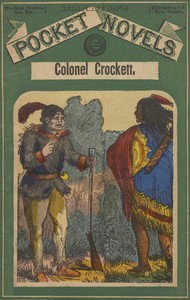
This digital edition of Colonel Crockett, the Texan trailer — Reading Notes is described by source-level measurements including 30,918 words, 2 hr 15 min estimated reading time, and 19 detected text sections.
The text analysis averages about 19.2 words per sentence, while the detected sections provide another way to judge how the source is divided.
Project Gutenberg metadata also associates the work with “Indians of North America -- Fiction,” connecting these edition facts with the source record’s subject description.
Explore this collection
These alternatives are selected using recorded categories and estimated reading time.
About 168 minutes
Adventure Picaresque Fiction
38,427 recorded words. 33 minutes difference from this book's estimate.
View Gutenberg source #69490About 199 minutes
Adventure Picaresque Fiction
45,558 recorded words. 64 minutes difference from this book's estimate.
View Gutenberg source #73917About 205 minutes
Adventure Picaresque Fiction
47,001 recorded words. 70 minutes difference from this book's estimate.
View Gutenberg source #68936Search stored excerpts and compare books → Choose by your preferences →
Choices use stored catalog measurements. Estimates vary with reading speed. A shared category is a catalog label, not a claim that two books have the same argument or literary quality.
Search reads excerpt text stored with this catalog and links to its associated Gutenberg record. The connection is stored in the site database; this tool does not recheck that every excerpt is word-for-word identical to that external record. Excerpt search does not cover every chapter and does not verify historical publication dates.
Catalog snapshot checked: 2026-09-25. Coverage: 95 public books, 95 available source excerpts.
Read the complete public-domain text at its original source.
Read on Project GutenbergThe novel opens with Davy Crockett bursting into a clearing and demanding, "did you see any thing of a confounded big b'ar passing this way?" The question is answered by Hans Bungslager, a "big Dutchman" whose comic dialect and literal-mindedness—asking if the bear was "flyin' mit his wings"—immediately establishes a contrast between Crockett's frontier savvy and the immigrant's bewildered humor. Ellis uses this exchange to showcase Crockett's patience and amusement, traits that define his portrayal throughout.
Later, the narrative shifts to a tense escape from Comanches, where Sebastian and Katrina navigate an underground passage. The author's descriptive choices—"pitchy darkness," "soft earth," "vigorous currant bushes"—ground the action in sensory detail, while the careful pacing of the escape reflects a different authorial strategy: building suspense through methodical, step-by-step movement rather than comic banter.
Ellis relies heavily on dialect to distinguish his characters, most notably in the opening chapter. Hans Bungslager speaks in a thick German accent: "Hooh! vat you said?" and "Yaw, I vos." His confusion over the word "bear"—mistaking it for "bare" as in "bald-headed eagle"—creates a running joke that Crockett indulges. The humor is broad but effective, marking Hans as a comic figure whose literal interpretations contrast with Crockett's quick wit.
This dialect work is not merely decorative. It signals social and cultural difference within the frontier setting. Hans's speech patterns—"I hash not seen notting of him"—are rendered phonetically, inviting the reader to hear his voice. Crockett, by contrast, speaks in colloquial but standard English, using frontier idioms like "ring-tailed roarer" and "regular whopper." The linguistic divide reinforces the power dynamic: Crockett is the competent woodsman, Hans the bumbling outsider.
When Sebastian and Katrina plan their escape from the besieged house, Ellis shifts from comic banter to taut, procedural description. The passage is built around small, deliberate actions: checking the walls, firing a gun to mislead the Comanches, groping in the dark, loosening planks. Each step is narrated with care: "Groping around with his hands, he speedily got hold of the planking, and only a little exertion was necessary to draw it loose."
The author controls tension by alternating between action and pause. After Sebastian loosens the earth, "an alarming yawn occurred—much larger than was anticipated," and they stop to listen. This moment of hesitation, followed by cautious peering, creates a rhythm of risk and restraint. Ellis avoids melodrama; the danger is conveyed through the characters' careful movements and the physical details of the tunnel—"cool passage," "pitchy darkness"—rather than through exclamation or hyperbole.
Setting is not merely backdrop in this novel; it actively shapes what characters can do. The underground passage that Sebastian and Katrina use is a man-made feature—"an underground communication, which uncle Hans made last summer"—that becomes a tactical asset. Ellis describes its dimensions: "about thirty feet in extent," requiring them to "stoop quite low." The physical constraints of the tunnel dictate the pace of the escape.
Similarly, the clearing where Crockett meets Hans is a small open space that forces a confrontation. The forest is "dense," and Crockett emerges "at full speed," suggesting a landscape that both conceals and reveals. Later, the currant bushes outside the cellar provide "an effectual screen" for Sebastian's crawl to the woods. These details are functional: they explain how characters move unseen and why certain plans succeed or fail. Ellis uses setting to create plausible obstacles and solutions, grounding the adventure in a tangible world.
Ellis writes in a brisk, declarative style typical of dime novels, but he varies his sentence structure to match the mood. Comic scenes use short, punchy lines: "Crockett laughed." "And the Dutchman laughed." The repetition of "laughed" underscores the shared amusement. In tense scenes, sentences lengthen and accumulate detail: "The Texan concluded to make a survey from each window before going, and he did so, scrutinizing every part of the clearing and wood with all the care possible."
The narrator occasionally steps back to comment on character, as when he notes "There was no little humor in Colonel Crockett." This direct address to the reader is a hallmark of the dime novel tradition, creating a sense of intimacy. Ellis also uses physical description to convey emotion: Hans "shaking with laughter, like so much jelly" is a vivid, almost cartoonish image. The author's choices in diction—"whopper," "blunderbuss," "cavern-like opening"—keep the language accessible and energetic, suited to a serialized adventure audience.
Readers attentive to authorial craft will find in this dime novel a careful balancing of humor and suspense, achieved through dialect, pacing, and setting. Ellis does not simply chronicle events; he shapes them through linguistic and structural choices that reward close reading. The opening bear-hunt scene and the cellar escape, though tonally distinct, both demonstrate a writer working within genre conventions to create vivid, memorable episodes.
Reading Ellis’s bear hunt in Colonel Crockett, I felt that same quiet pause before a hard choice—how detail slows time. It reminded me of Next year — Context and Discussion, where a similar waiting hangs in the air. Two different worlds, yet both keep that breath held, just before something turns.
Use these questions to collect your thoughts before moving on.