About 207 minutes
The Indian queen — Reading Companion
Adventure Picaresque Fiction
47,498 recorded words. 11 minutes difference from this book's estimate.
View Gutenberg source #74912
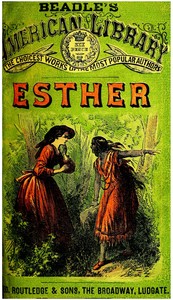
The catalog record for Esther — Inside the Classic provides practical reading context through 49,993 words, 3 hr 38 min estimated reading time, and 20 detected text sections.
The text analysis averages about 18.7 words per sentence, while the detected sections provide another way to judge how the source is divided.
Project Gutenberg metadata also associates the work with “Indians of North America -- Fiction,” connecting these edition facts with the source record’s subject description.
Explore this collection
These alternatives are selected using recorded categories and estimated reading time.
About 207 minutes
Adventure Picaresque Fiction
47,498 recorded words. 11 minutes difference from this book's estimate.
View Gutenberg source #74912About 205 minutes
Adventure Picaresque Fiction
47,001 recorded words. 13 minutes difference from this book's estimate.
View Gutenberg source #68936About 199 minutes
Adventure Picaresque Fiction
45,558 recorded words. 19 minutes difference from this book's estimate.
View Gutenberg source #73917Search stored excerpts and compare books → Choose by your preferences →
Choices use stored catalog measurements. Estimates vary with reading speed. A shared category is a catalog label, not a claim that two books have the same argument or literary quality.
Search reads excerpt text stored with this catalog and links to its associated Gutenberg record. The connection is stored in the site database; this tool does not recheck that every excerpt is word-for-word identical to that external record. Excerpt search does not cover every chapter and does not verify historical publication dates.
Catalog snapshot checked: 2026-09-25. Coverage: 95 public books, 95 available source excerpts.
Read the complete public-domain text at its original source.
Read on Project GutenbergFrom its first sentence—'Our every footstep treads upon a grave!'—Ann S. Stephens's Esther announces itself as a story haunted by the dead. The opening chapter, 'Westward,' sets a funereal tone: the narrator describes the Oregon Trail as a path over the bones of a 'people almost extinct,' their graves plowed up by Anglo-Saxon settlers who pick up arrowheads 'as if he did not know what soil his sacrilegious plow was upturning.' This elegiac voice, at once poetic and accusatory, frames the captivity plot that follows. Esther, a young white woman, is taken by the Dakota chief Osse’o, then claimed by a Mormon elder named Waltermyer, whose pious rhetoric masks greed and violence. Stephens uses the novel to stage a collision between three forces: the vanishing Indian, the hypocritical Mormon, and the 'star that leads civilization westward.'
The novel’s opening paragraph is a sustained meditation on graves—literal and figurative. Stephens writes that beneath 'the quick, firm tread of business men' and 'the daintily-slippered feet of lovely women' lie 'the mouldering form—the dust of stalwart men.' This is not mere gothic flourish; it is a political argument. The narrator insists that the westward march of 'civilization' is a sacrilege, turning Native burial grounds into cornfields. The image recurs when the Dakota chief Black Eagle falsely claims that Osse’o 'has fallen over the cliff'—a lie that covers up a murder, just as the plow covers up the dead. The narrator’s voice, however, refuses to let the dead stay buried. By framing the entire story as a walk over graves, Stephens forces the reader to see the trail not as a path to opportunity but as a site of erasure.
Waltermyer, the Mormon elder, is the novel’s most vividly drawn villain, and his hypocrisy is laid bare in his speech. After a near-fatal fall, he does not thank God but asks, 'Where’s my horse?' Then, in the same breath, he claims divine protection: 'The prophet of the Lord was saved for the great work.' Stephens underscores the blasphemy by having him quote scripture—'the grossest sin of earth is disobedience'—while he lies bleeding from his own greed. His sermonizing is interrupted by a follower who offers a horse, but Waltermyer’s mind is fixed on 'the prize he had ventured so much for'—Esther. The narrator’s commentary is scathing: 'Were there ever blasphemous words like these uttered in a situation so painful?' The contrast between his pious cant and his ruthless pursuit of a captive woman exposes the gap between religious language and moral action.
While Waltermyer talks endlessly, the Dakota characters act with economy. When Black Eagle explains Osse’o’s death, he offers a single sentence: 'His foot was not sure on the path.' No elaboration, no lament. The lie is 'monstrous,' but the narrative does not give the reader access to the chief’s interior. Esther, meanwhile, 'fainted on the saddle to which she was bound'—a detail that emphasizes her passivity and physical vulnerability. The excerpts offer little of her perspective; she is acted upon, carried, claimed. This asymmetry—between the verbose Mormon and the laconic chief, between the narrator’s elegiac commentary and Esther’s silence—creates a tension that the novel does not resolve. The reader is left to wonder whether Esther’s voice will ever emerge from the competing claims made over her body.
Stephens’s Esther is a captivity narrative that resists easy sympathies. The narrator mourns the destruction of Native peoples, yet the Dakota characters remain opaque; the Mormon elder is a villain, yet his followers are credulous, not evil. Readers should attend to the novel’s structural tensions—between speech and silence, between the plow and the grave—rather than expecting a clear moral hierarchy. The trail, in this telling, leads not to a promised land but to a contested ground where the dead have not yet been forgotten.
Reading about Esther’s captivity, I remembered sitting on my grandmother’s porch, feeling the weight of a landscape that held other people’s grief. The same ache returned with My lady of Cleeve — Background and Themes, where a house’s quiet rooms seemed to whisper of choices made under duress. Both books left me with a sense of sorrow that lingers, like dust on an old window.
Answer a few questions and save a private reflection on this device.