About 331 minutes
The small bachelor — Background and Themes
Fantasy Juvenile Worlds
75,971 recorded words. 30 minutes difference from this book's estimate.
View Gutenberg source #70041
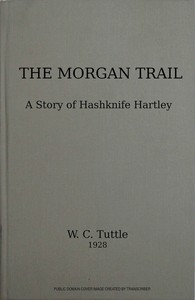
For The Morgan trail — Edition Insights, the stored edition analysis reports 69,184 words, 5 hr 1 min estimated reading time, and 21 detected text sections.
The text analysis averages about 11.4 words per sentence, while the detected sections provide another way to judge how the source is divided.
Project Gutenberg metadata also associates the work with “Western stories,” connecting these edition facts with the source record’s subject description.
Explore this collection
These alternatives are selected using recorded categories and estimated reading time.
About 331 minutes
Fantasy Juvenile Worlds
75,971 recorded words. 30 minutes difference from this book's estimate.
View Gutenberg source #70041About 262 minutes
Fantasy Juvenile Worlds
60,226 recorded words. 39 minutes difference from this book's estimate.
View Gutenberg source #70944About 375 minutes
Fantasy Juvenile Worlds
86,202 recorded words. 74 minutes difference from this book's estimate.
View Gutenberg source #75384Search stored excerpts and compare books → Choose by your preferences →
Choices use stored catalog measurements. Estimates vary with reading speed. A shared category is a catalog label, not a claim that two books have the same argument or literary quality.
Search reads excerpt text stored with this catalog and links to its associated Gutenberg record. The connection is stored in the site database; this tool does not recheck that every excerpt is word-for-word identical to that external record. Excerpt search does not cover every chapter and does not verify historical publication dates.
Catalog snapshot checked: 2026-09-25. Coverage: 95 public books, 95 available source excerpts.
Read the complete public-domain text at its original source.
Read on Project GutenbergThe Morgan Trail opens with a young man, Rex Morgan, returning from his mother's funeral to a porch in Northport, California. He is twenty, pale, and ignorant of the world—educated by tutors, never allowed to attend school. The first chapter dwells on his isolation: his mother was an enigma to neighbors, her income unknown, and Rex now faces a sudden, crushing aloneness. The prose lingers on his threadbare suit, his confusion over casket handles, and the skyline he stares at without comprehension. This quiet, almost domestic beginning contrasts sharply with the violent western landscape that soon follows.
The novel's structure hinges on a sharp movement between Rex's sheltered interior world and the raw action of the range. Early chapters are dominated by Rex's internal bewilderment—he wonders who will pay for the funeral, realizes he has no money, and recalls that his mother never spoke of relatives. The narrative voice here is subdued, almost clinical in its catalog of his ignorance. But by the later excerpt, Rex is holding a heavy shotgun at fifteen feet, bluffing four armed men with an unloaded weapon. The transition is abrupt: the same boy who did not know where his money came from now outsmarts a lynch mob. Tuttle uses this contrast to underscore Rex's growth, but also to keep the reader off-balance, shifting between psychological interior and physical threat.
A recurring image in the excerpts is the unloaded shotgun. Rex picks it up, aims it, and the captors freeze—'Even a tenderfoot could score a bull’s-eye with a shotgun at fifteen feet.' The tension breaks only when Hashknife reveals the gun is empty, and the narrative pivots: the bluff succeeds, but the danger remains. This moment is not just a plot point; it echoes the novel's broader pattern of deception and exposure. Earlier, Rex's mother shielded him from the world; now he shields others with a lie. The gun's emptiness mirrors the emptiness of Rex's former life, and its bluff becomes a turning point. Tuttle repeats this motif of hidden truth—the Navajo rug, the empty safe, the black mask—each object a clue that the surface is not reliable.
The story moves restlessly between enclosed, domestic settings and the open range. The first chapter is anchored to a front porch and a skyline; later scenes shift to a kitchen doorway, a bedroom, and then to horses riding away in darkness. This back-and-forth creates a rhythm of confinement and release. Rex is initially trapped by his upbringing, then physically cornered in a house with a shotgun. Hashknife and Sleepy drift in and out, their movements described with casual ease—'Hashknife and Sleepy followed them out to their horses.' The landscape itself becomes a character: the hills where Walter hides, the trail to Cañonville, the darkness that swallows riders. Tuttle uses these transitions to heighten suspense, but also to suggest that safety is always temporary, and that the next scene may explode into violence.
The dialogue in the excerpts is terse and weighted. Hashknife speaks in clipped commands—'Step into the middle of the room'—while Rex's speech is hesitant and formal: 'I just saw the gun in the corner, and thought I might frighten them with it.' This contrast in voice reinforces the generational and experiential gap between the cowboys and the tenderfoot. Tuttle also uses dialogue to shift power: when Eller calls Hashknife a 'hatchet-faced bum,' the insult triggers a direct challenge. The standoff is resolved not by gunfire but by words—Eller admits, 'Mebby I did lie, Hartley.' The structure of these scenes relies on verbal escalation and deflation, with the unloaded gun as the ultimate rhetorical device. The reader is left to parse who is bluffing and who is not, a puzzle that drives the narrative forward.
Readers attentive to the novel's structure will notice how Tuttle builds tension through alternating scenes of introspection and action, and how objects—a shotgun, a rug, a safe—carry double meanings. The Morgan Trail rewards a careful eye for the moments when characters reveal themselves through what they do not say, and when the landscape itself becomes a mirror for their isolation. Approach the text as a puzzle of movement and stillness, where every shift in setting signals a shift in power.
I remember sitting on a porch swing in late summer, the pages of The Morgan Trail warm in my hands, thinking about how trust can feel like a bluff—solid until someone calls it. That same unease stayed with me through The trail of the serpent — Reading Notes, where every clue seemed to double back on itself, mirroring the muddle of that afternoon’s own quiet disbelief.
Your answers remain private and are stored only in this browser.