About 449 minutes
The lonely house — Inside the Classic
England London Nineteenth Century Fiction
103,172 recorded words. 3 minutes difference from this book's estimate.
View Gutenberg source #70698
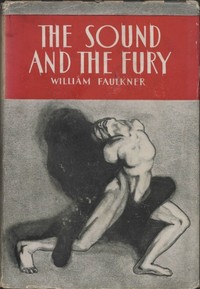
This digital edition of The sound and the fury — Text and Context is described by source-level measurements including 102,431 words, 7 hr 26 min estimated reading time, and 10 detected text sections.
The text analysis averages about 11.5 words per sentence, while the detected sections provide another way to judge how the source is divided.
Project Gutenberg metadata also associates the work with “Psychological fiction,” connecting these edition facts with the source record’s subject description.
Explore this collection
These alternatives are selected using recorded categories and estimated reading time.
About 449 minutes
England London Nineteenth Century Fiction
103,172 recorded words. 3 minutes difference from this book's estimate.
View Gutenberg source #70698About 449 minutes
England London Nineteenth Century Fiction
103,251 recorded words. 3 minutes difference from this book's estimate.
View Gutenberg source #73133About 434 minutes
England London Nineteenth Century Fiction
99,731 recorded words. 12 minutes difference from this book's estimate.
View Gutenberg source #75790Search stored excerpts and compare books → Choose by your preferences →
Choices use stored catalog measurements. Estimates vary with reading speed. A shared category is a catalog label, not a claim that two books have the same argument or literary quality.
Search reads excerpt text stored with this catalog and links to its associated Gutenberg record. The connection is stored in the site database; this tool does not recheck that every excerpt is word-for-word identical to that external record. Excerpt search does not cover every chapter and does not verify historical publication dates.
Catalog snapshot checked: 2026-09-25. Coverage: 95 public books, 95 available source excerpts.
Read the complete public-domain text at its original source.
Read on Project GutenbergThe novel opens with Benjy Compson, a thirty-three-year-old man with an intellectual disability, watching golfers through a fence. His narration is immediate and sensory: 'Through the fence, between the curling flower spaces, I could see them hitting.' The scene is anchored by Luster, the caretaker, who scolds Benjy for moaning and searches for a lost quarter. But Benjy's mind drifts—'Caddy uncaught me and we crawled through'—sliding without transition into a memory of his sister Caddy. This movement between present and past, triggered by a word or a sensation, establishes the novel's structural principle: time is not linear but associative, and the fence becomes a recurring image of separation and longing.
The fence appears repeatedly in Benjy's section, both as a physical barrier and as a boundary between memory and the present. Benjy watches the golfers through it, holds to it, and follows it to the broken place where he and Caddy once crawled through. The fence separates him from the game, from the past, and from Caddy. When Luster says, 'We done looked there. They aint no more coming right now,' the fence also marks the limit of what can be retrieved. The image recurs in later sections: in Quentin's section, the fence is absent, but the idea of enclosure—the walls of Harvard, the carriage, the bridge—echoes Benjy's confinement. The fence is not just a prop; it is a structural motif that ties the four narratives together, each character facing their own version of it.
In Benjy's narration, the word 'caddie' from the golfers triggers a memory of his sister Caddy. He hears 'Here, caddie' and immediately the text shifts: 'Caddy uncaught me and we crawled through.' The name is a sensory key that unlocks a flood of past moments—Caddy's smell, her voice, her care. This is not a simple flashback; it is a structural device that collapses time. For Benjy, Caddy is not a memory but a presence that intrudes on the present. The novel's first section is built on such triggers: the smell of trees, the feel of grass, the sound of a name. Later sections will use different triggers—Quentin's watch, Jason's anger—but the pattern is set: the past is never past, and the name 'Caddy' is the most potent of all.
Benjy's section moves between scenes without any narrative marker. One moment he is at the fence with Luster; the next, he is a child crawling through the garden with Caddy. The shift is signaled only by a change in sensory detail: 'The ground was hard. We climbed the fence, where the pigs were grunting.' This technique forces the reader to navigate the text as Benjy experiences time—not as a sequence but as a series of overlapping moments. The same method appears in Quentin's section, where his thoughts jump from his watch to his father to the smell of gasoline, but with more abstract language. The structure of the novel thus mirrors the consciousness of its narrators, each section demanding a different kind of attention from the reader.
The excerpts contain a tension between natural imagery and industrial objects. Benjy's world is full of 'bright grass,' 'flower tree,' and 'pasture,' but also the fence, the golf course, and the 'flag' that flutters like a manufactured object. In Quentin's section, the pastoral gives way to the urban: 'the chimes did begin and I went on while the notes came up like ripples on a pool'—a simile that brings nature into the city. But the dominant images are mechanical: the watch that 'clicked away, not knowing it couldnt even lie,' the gasoline, the 'lights—yellow and red and green—trembled in the clear air.' This shift from the natural to the industrial reflects the Compson family's decline, as the old agrarian order gives way to a modern world that offers no comfort. The novel's structure, moving from Benjy's sensory immersion to Quentin's abstract rumination, traces this same arc.
The novel's four sections are not chapters in a conventional sense; they are distinct voices that require the reader to recalibrate with each shift. Pay attention to recurring words and images—the fence, the name Caddy, the smell of trees—as they function as anchors across the narrative. The text does not explain itself; meaning emerges from the collision of perspectives. Reading with an eye to structure, rather than plot, reveals how Faulkner uses fragmentation to explore memory, loss, and the impossibility of escape.
There’s a particular ache in reading Benjy’s section—how the past keeps surfacing, unbidden, in the middle of the present. It makes me think of old mysteries, where a single name or detail refuses to stay buried. I find myself returning to such books, much like Faulkner’s characters return to that fence. One such quiet companion is The duplicate death — Inside the Classic, which holds its own ghosts gently. I remember the first time I finished it, just sitting still for a while.
Build a private reading journal entry for this title.









