About 224 minutes
The scarlet car; The Princess Aline — Edition Insights
England London Nineteenth Century Fiction
51,489 recorded words. 7 minutes difference from this book's estimate.
View Gutenberg source #69715
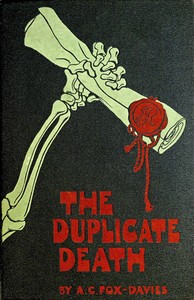
The duplicate death — Inside the Classic can be approached with a clearer sense of reading commitment from its source measurements: 49,867 words, 3 hr 37 min estimated reading time, and 13 detected text sections.
The text analysis averages about 16.5 words per sentence, while the detected sections provide another way to judge how the source is divided.
Project Gutenberg metadata also associates the work with “Inheritance and succession -- Fiction,” connecting these edition facts with the source record’s subject description.
Explore this collection
These alternatives are selected using recorded categories and estimated reading time.
About 224 minutes
England London Nineteenth Century Fiction
51,489 recorded words. 7 minutes difference from this book's estimate.
View Gutenberg source #69715About 234 minutes
England London Nineteenth Century Fiction
53,649 recorded words. 17 minutes difference from this book's estimate.
View Gutenberg source #69322About 235 minutes
England London Nineteenth Century Fiction
54,004 recorded words. 18 minutes difference from this book's estimate.
View Gutenberg source #71359Search stored excerpts and compare books → Choose by your preferences →
Choices use stored catalog measurements. Estimates vary with reading speed. A shared category is a catalog label, not a claim that two books have the same argument or literary quality.
Search reads excerpt text stored with this catalog and links to its associated Gutenberg record. The connection is stored in the site database; this tool does not recheck that every excerpt is word-for-word identical to that external record. Excerpt search does not cover every chapter and does not verify historical publication dates.
Catalog snapshot checked: 2026-09-25. Coverage: 95 public books, 95 available source excerpts.
Read the complete public-domain text at its original source.
Read on Project GutenbergThe novel opens with a compact biography of Lord Madeley, tracing his descent from Plantagenets and Stuarts, his eccentric reclusiveness in Bloomsbury, and the financial decline of his family. This backstory is not mere scene-setting; it establishes a pattern of inheritance and secrecy that drives the plot. The title itself, The Duplicate Death, hints at doubling, and the text soon delivers: forged bills, disguised handwriting, and a bank account opened under a false name. The narrative moves briskly from the Madeley household to a courtroom, where the cross-examination of a money-lender reveals a chain of anonymous transactions.
The story’s geography is telling. Lord Madeley’s lodgings in Bloomsbury—a district associated with intellectual and bohemian life—contrast with the ancestral manor and the West-end halls where the Alvarez sisters performed. The narrative shifts from these domestic and theatrical spaces to the formal arena of the police court. In the excerpted cross-examination, the setting is almost entirely the witness box: the money-lender Isaacson produces letters, the magistrate passes them to counsel, and a bank clerk testifies to an account opened by a Mr. Everard Clarke. The physical movement is minimal—papers are handed, notes are produced—but the legal machinery grinds forward. This compression of action into procedural detail is a deliberate structural choice, foregrounding evidence over action.
Disguise operates not through costumes but through handwriting and paper. The forged letters are written on the notepaper of the firm Rellingham, Baxter, Marston & Moorhouse, but in a disguised hand. The bearer of the bills is unidentified; the messenger is assumed to be a clerk. The bank account is opened by a Mr. Everard Clarke, whose references prove fictitious. Each layer of the transaction is a mask. The money-lender keeps his own books, so no clerk can connect a messenger to a specific deal. The bank clerk cannot identify Clarke. The narrative repeatedly emphasizes the absence of reliable witnesses: the messenger is unseen, the handwriting is disguised, the addresses are accommodation addresses. This pattern of obscured identity is the novel’s central mechanism.
The Madeley inheritance is not just a plot point but a structural device. The opening chapter details the impoverishment of the younger son, the draining of the estate by the second brother, and the auction of the Manor House’s contents. This history of depleted resources and contested succession sets up the financial pressures that motivate forgery and murder. The legal firm’s casual statement that they could have lent Lord Deverell £500 or £5000 “for the mere asking” underscores the contrast between the family’s ancient name and its modern liquidity crisis. The duplicate death of the title may refer to more than one corpse; it may also point to the duplication of documents—bills, letters, signatures—that threaten to replicate the original crime.
The extended courtroom scene in the excerpts functions as a set piece where the novel’s themes of performance and evidence collide. The barrister Tempest cross-examines the money-lender with mounting frustration: each question reveals another gap in identification. The witness cannot say who brought the bill, cannot recognize the messenger, cannot identify the prisoner. The magistrate’s interjections (“Have the notes been traced?”) and the prosecuting solicitor’s replies (“I’m going to call evidence”) create a rhythm of expectation and deferral. The prisoner is remanded. The scene ends with the solicitor declaring the letters “absolute forgeries.” This is not a resolution but a staging of uncertainty, leaving the reader to piece together the duplicate traces.
Readers will find that the novel rewards attention to paper trails and legal formalities. The movement between aristocratic backstory and procedural interrogation is not accidental; it mirrors the tension between inherited status and criminal evidence. The duplicate death may be a literal event, but the text suggests that duplication—of documents, identities, and scenes—is the true subject. Approach the courtroom chapters as carefully constructed puzzles, and note how each piece of paper carries the weight of the plot.
Rereading the duplicated documents and courtroom echoes in Fox-Davies’s mystery, I found myself drifting to another sort of legal tangle—one with a quieter, more intimate urgency. The Duplicate Death lingers on masks and paperwork, but something in its careful unveiling reminded me of how a secret can live inside a gesture. That same slow unfurling waits in Rena's experiment — Inside the Classic, and I smiled at the kinship.
Build a private reading journal entry for this title.









