About 336 minutes
Tragedy at Ravensthorpe — Context and Discussion
England London Nineteenth Century Fiction
77,221 recorded words. 1 minutes difference from this book's estimate.
View Gutenberg source #75407
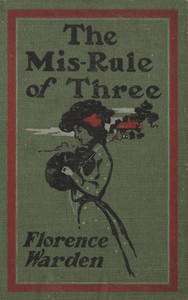
The mis-rule of three — Background and Themes can be approached with a clearer sense of reading commitment from its source measurements: 77,012 words, 5 hr 35 min estimated reading time, and 7 detected text sections.
The text analysis averages about 18.8 words per sentence, while the detected sections provide another way to judge how the source is divided.
Project Gutenberg metadata also associates the work with “Young women -- Fiction,” connecting these edition facts with the source record’s subject description.
Explore this collection
These alternatives are selected using recorded categories and estimated reading time.
About 336 minutes
England London Nineteenth Century Fiction
77,221 recorded words. 1 minutes difference from this book's estimate.
View Gutenberg source #75407About 337 minutes
England London Nineteenth Century Fiction
77,366 recorded words. 2 minutes difference from this book's estimate.
View Gutenberg source #74886About 331 minutes
England London Nineteenth Century Fiction
76,072 recorded words. 4 minutes difference from this book's estimate.
View Gutenberg source #69087Search stored excerpts and compare books → Choose by your preferences →
Choices use stored catalog measurements. Estimates vary with reading speed. A shared category is a catalog label, not a claim that two books have the same argument or literary quality.
Search reads excerpt text stored with this catalog and links to its associated Gutenberg record. The connection is stored in the site database; this tool does not recheck that every excerpt is word-for-word identical to that external record. Excerpt search does not cover every chapter and does not verify historical publication dates.
Catalog snapshot checked: 2026-09-25. Coverage: 95 public books, 95 available source excerpts.
Read the complete public-domain text at its original source.
Read on Project GutenbergFlorence Warden opens The Mis-rule of Three by situating her three protagonists in a specific, shabby-genteel London geography: a tall house off Tottenham Court Road where the landlady, Mrs Inkersole, struggles to maintain respectability amid a shifting population of foreign and domestic undesirables. The second-floor 'Diggings' are the enduring domain of the 'famous Three'—Bartlett Bayre, a clerk and struggling writer; Ted Southerley, a journalist; and Jan R., a painter yet to be admitted to the Academy or New Gallery. Warden establishes their characters through the objects and conditions of their rooms: Bayre's outward neatness masking internal disorder, Southerley's stolid Northern pragmatism, and Jan's irascible wit. The prose is brisk and observational, with a fondness for cataloguing social types and domestic details that ground the bohemian comedy in a tangible, slightly seedy reality.
Warden's descriptive choices consistently emphasize the tension between aspiration and decay. The house at No. 46 makes 'a valiant attempt to hold its own in the respectable class' while surrounded by 'dingy foreigners of the undesirable class.' The landlady's furniture is described with ironic precision: 'solid mahogany and second-hand chenille curtains' on the ground floor, 'alleged Sheraton upholstered in vivid plush and brocade' on the first. The upper rooms are a 'rabbit warren,' and Bayre's neat exterior conceals a wardrobe and chest of drawers whose 'internal condition' leaves 'much to be desired in the way of order.' This pattern of surface versus interior recurs throughout the excerpts, mirroring the mystery of the baby's true parentage. Warden's vocabulary—'brat,' 'animal,' 'co-operative kid'—shifts between affectionate and exasperated registers, reflecting the men's ambivalent guardianship.
The epistolary section of Jan's letter to Bayre showcases Warden's ability to differentiate voices through rhythm and complaint. Jan's prose is colloquial and aggrieved: 'I hate a fellow who can't think of anything else when he's got a love-affair on hand! Why, I can manage half a dozen at a time, and never miss an appointment or forget to post a letter!' The letter piles up grievances—the smirking maid Susan, a top-floor tenant singing 'Molly and I and the baby,' Southerley's pretexts to visit Miss Merriman—with a comic exasperation that reveals Jan's own vanity and impatience. His threat to take the baby to the workhouse 'in a brown-paper parcel' is hyperbolic but grounded in the material specifics of the household. In contrast, Bayre's response is 'reassuring but vague,' and his later confrontation with Marie Vazon shows a more direct, suspicious tone: 'What has become of Monsieur Bayre's child?' The dialogue thus maps the three men's differing temperaments—Jan's bluster, Bayre's cautious inquiry, Southerley's stolidity—through their speech patterns.
The infant at the center of the plot is never named in the excerpts, referred to only as 'the brat,' 'the animal,' 'the co-operative kid,' or 'the baby.' This deliberate vagueness keeps the child an object of negotiation rather than a character. Warden uses the baby to expose the men's domestic incompetence and their reliance on Miss Merriman, the young woman who cares for it. Jan's letter reports that she 'seems to be getting rather anxious at our not hearing from you,' suggesting her patience is finite. The baby also triggers the mystery: Bayre's investigation in France reveals that the child in Marie Vazon's care is not the one entrusted to her—a younger child with red hair substituted for the flaxen-haired son of old Monsieur Bayre. Warden handles this revelation through Bayre's observational detail: 'This child's hair is red, what there is of it, while Mr Bayre's son has hair almost flaxen.' The baby thus functions as a puzzle piece, its physical traits becoming clues in a larger deception.
Warden's London is a city of precarious lodgings and permeable boundaries. The house on Tottenham Court Road is 'tall, old-fashioned, roomy' but past its prime, and its respectability is constantly threatened by the 'undesirable class' of foreigners and homegrown types who occasionally penetrate even No. 46. The 'Diggings' themselves are a masculine space of shared bachelorhood, but the baby's arrival feminizes and disrupts it: the maid Susan grins and 'cheeks' the men, and a top-floor tenant sings mocking doggerel. Warden also contrasts the London setting with the French episode, where Bayre gains entry to the Vazon house 'by a ruse, with a boy who was delivering logs for fuel.' The international dimension—a baby possibly swapped in France—broadens the novel's scope beyond the bohemian enclave. The setting thus serves not merely as backdrop but as a marker of class anxiety, domestic instability, and the porousness of private life.
Readers attentive to Warden's craft will notice how she builds suspense through small, concrete details: the color of a baby's hair, the internal disorder of a tidy room, the precise wording of a threatening letter. The novel rewards close attention to its dialogue and description, where character and plot emerge not from grand statements but from the accumulation of everyday irritations and observations. The excerpts suggest a story that balances mystery with social comedy, anchored in the material realities of early twentieth-century London lodging-house life.
Reading about those three bachelors tripping over an infant in Warden’s novel, I remembered my own cramped flat when my sister’s child came to stay—how the quiet vanished overnight. That strange weight of sudden obligation felt familiar, much like the hushed, awkward intimacy in Lady Chatterley's lover — Inside the Classic, where unwanted tenderness reshapes a household’s fragile balance.
A brief reflection can help important ideas stay with you longer.









