
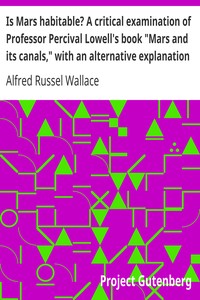
Is Mars habitable? A critical examination of Professor Percival Lowell's book…
In the early 1900s, the idea of life on Mars wasn't science fiction—it was a serious scientific proposal championed by the respected astronomer Percival Lowell. His book argued that intelligent Martians had constructed a globe-spanning network of canals to channel water from polar ice caps, a last-ditch effort to save their civilization on a drying world. The public and many academics were captivated.
The Story
This book is Wallace's direct response. He doesn't just disagree; he conducts a full audit. Using the available data, he picks apart Lowell's theory point by point. He calculates that Mars is far too cold for liquid water. He argues the atmosphere is too thin to support life as we know it. Those famous 'canals'? Wallace suggests they're likely optical illusions or natural features, not engineering marvels. He applies the principles of biology and physics to ask if the Martian environment could possibly allow for Lowell's complex scenario. The narrative is the process of his investigation, building a case against the romantic notion of a habitable Mars.
Why You Should Read It
What's thrilling is watching a great scientific mind at work. Wallace isn't being a contrarian for its own sake. He's showing how science self-corrects. He uses logic and existing knowledge to challenge a popular but poorly supported idea. It's a masterclass in critical thinking. You also get a real sense of his personality—a bit cantankerous, fiercely intelligent, and deeply committed to evidence. Reading this, you feel like you're sitting with him as he works through each problem, finding the flaws in the argument. It makes you a more careful reader and thinker.
Final Verdict
This is a perfect read for anyone who loves the history of science, astronomy, or a good intellectual debate. It's for people who enjoy seeing how ideas are tested and how pop-science myths get busted, even over a century ago. While we now have rovers on Mars, Wallace's core lesson—to question extraordinary claims and demand solid evidence—is timeless. It's a short, potent book that proves real scientific skepticism can be more dramatic than any fantasy.
The copyright for this book has expired, making it public property. Distribute this work to help spread literacy.



Sarah Hernandez
1 year agoSurprisingly enough, the pacing is just right, keeping you engaged. Highly recommended.